Wednesday, July 01, 2020

Constitutional Republic vs. Pure Democracy: How the U.S. Election Process Has Changed

Constitutional Republic vs. Pure Democracy: How the U.S. Election Process Has Changed“I pledge allegiance to the Flag of the United States and to the Republic for which it stands, one Nation under God, indivisible, with liberty and justice for all.”
Conservatives are generally quick to point out that America is a republic, not a democracy. But what really is the difference, and are they even right?
Voting in America has changed considerably since the days of our founding. Back then, the government didn’t even print official ballots. Instead, you got ballots from the candidate who wanted your support. Sometimes voting took place in public, so everyone knew who you voted for. And, of course, the franchise was largely restricted to white, male property owners.
Now, anyone who turns 18 can vote. And the Democratic Party wants to increase ballot access by automatically registering anyone who gets a driver's license. Democrats even pushed for mail-in ballots for the 2020 election to make voting even easier – and more open to voter fraud. But is any of this a good thing?
Indeed, it is worth considering the transformation of the United States from a Constitutional Republic, ruled by law with the input of the people, to a total democracy, where the will of the people dominates all other discussion.

A Brief History of the Franchise in America
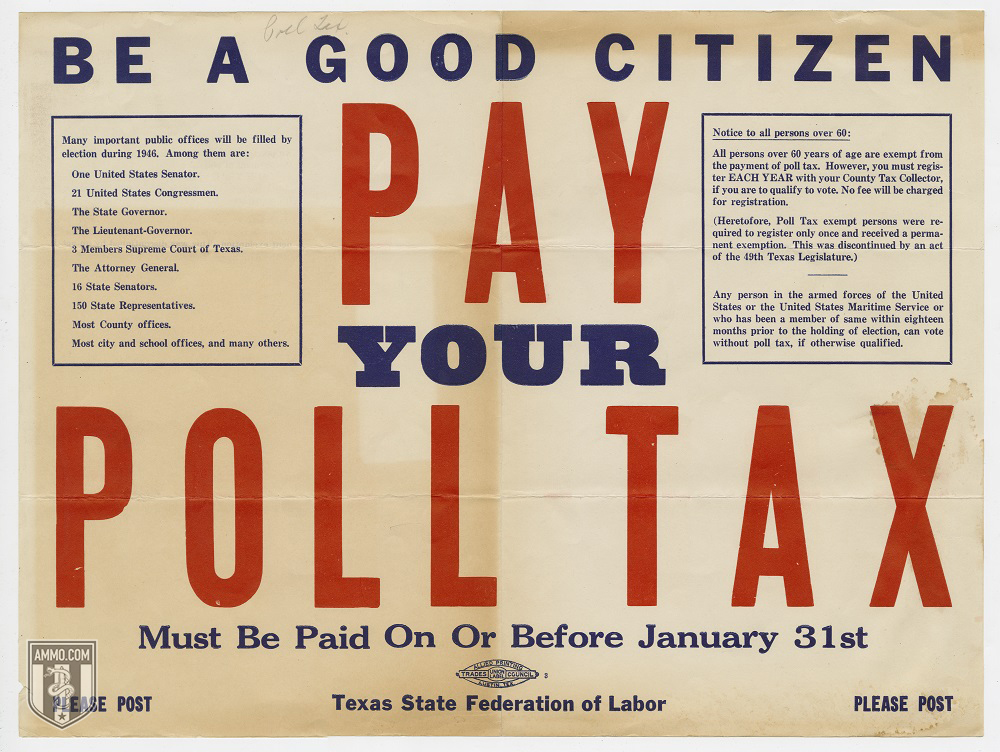
Constitutional Republic vs. Pure Democracy: How the U.S. Election Process Has ChangedOpen up your pocket Constitution and find the part where it says who can vote and who can’t. You’ll come up short. That’s because the Constitution delegates this right to the states. And while there are some amendments that, for example, say states can’t restrict the franchise on the basis of race, gender or being over the age of 18, otherwise there is broad leeway given in terms of who can vote and who can’t.
Before the United States existed, people were still voting and there were oftentimes even more restrictions in place. Property qualifications were most common, but there was often also a religious test involved. For example, Plymouth Colony required that voters be “orthodox in the fundamentals of religion,” which would have likely excluded even Catholics from voting. Indeed, Catholics, Quakers and Baptists were frequently forbidden from voting in early colonial elections. (Jews were forbidden from state office in Maryland until 1828, because of a state law requiring affirmation of belief in an afterlife.)
One of the first laws drafted by the new nation was a process for people to become citizens and thus be able to vote in places where citizenship was a requirement to do so – and indeed, citizenship was not a requirement in many states or colonies in the early days of America. While only “natural born” citizens can become president, naturalized citizens enjoy the full benefits of the franchise. There is still much debate as to what qualifies as a “natural born” citizen, and it’s worth noting that several recent major party presidential candidates were not born in the United States – most recently Tulsi Gabbard (who was born in American Samoa) and Ted Cruz (who was born in Canada). The Republican nominee in 2008, John McCain, was born in the Panama Canal Zone. The last of these was the most problematic, as Downes v. Bidwell ruled that unincorporated territories were explicitly not the United States.
While it is easy to ascribe this to petty religious bigotry, the reason is actually somewhat more profound: The colonists and the colonial governments that they formed considered it important to only allow the franchise to people who shared their values. Thus, those with heterodox religious beliefs were not allowed to vote on the grounds that doing so would undermine both the values and the liberty of the colony.
Similarly, property holders were meant to be the main voters for the simple reason of having skin in the game. The early colonists did not want, for example, the merchant class to have an outsized say in politics because they were not tied to the land and thus not as subject to bad decisions. A shopkeeper or importer can simply sell their stock and move on to the next colony. A freeholder, working the land with his family, has far less flexibility and, the theory goes anyway, would be making more long-term decisions about what is best for the polity.
What this meant, also, is that, in places like New Jersey, women were allowed to vote until 1807, provided that they could meet the property requirement. What changed in the early 19th century, under the expansion of the franchise under Jacksonian Democracy, was that race and gender were prized more than property rights. But free blacks still had the right to vote in some Northern states until 1838.
This too was not an arbitrary distinction. Men who had been veterans of the War of 1812, or at the very least, defended their community against Indian raids, believed that they were entitled to the franchise on the basis of that service. By 1856, free white men were allowed to vote without meeting any property requirements, but five of the states still kept tax requirements (frequently a poll tax) in place. Again, this makes sense: The force of government is largely about the spending of taxes and the use of the military.
By 1856, all property requirements had been lifted, but tax requirements remained in place in Rhode Island and Pennsylvania, until the 20th century. Rhode Island had what was basically a brief, low-level civil war over the question of property requirements known as the Dorr War. Indeed, anytime that post-Civil War disenfranchisement is discussed, it must include a discussion of the disenfranchisement of poor whites as well. The Battle of Athens is a fascinating tale of World War II veterans returning from battle and refusing to be shafted at the ballot box anymore.
Of the 15 Constitutional Amendments passed since the Civil War, four involve the franchise. The 15th Amendment bars states from restricting the franchise on the basis of race, the 19th from restrictions on the basis of gender, the 24th bars any tax requirements, and the 26th bars any age restrictions against those over the age of 18. Another Amendment, the 17th, allows for the direct election of senators, rather than having them elected by the respective state legislature – another expansion of pure democracy in America, though not an expansion of suffrage per se.
The previous method of electing senators, having them appointed by the respective state legislatures, was not an oversight on the part of the Founders. Rather, this was to give a voice to the state governments in the federal government. This was seen as an important safeguard against the overreach of federal power. Among other things, the Senate was a check on a power-hungry federal government seeking to put its tentacles into anything it could. It was a form of distributed power that was yet another attempt by the Founders to prevent consolidation and centralization of government.
It’s worth noting that Western states, starting with Wyoming in 1869, were granting women the right to vote, largely as an enticement to get them to move to the region, which was seriously devoid of women.
The concept of “one man, one vote” is the cornerstone of a more pure democracy. There were three decisions of the Earl Warren Supreme Court that definitively transformed the landscape of America into a democracy:
  • Baker v. Carr found that federal courts had jurisdiction over state redistricting efforts.
  • Wesberry v. Sanders found that U.S. House of Representatives districts – whose borders are determined by state governments – must be roughly equal in population.
  • Reynolds v. Sims found that state legislature districts must be roughly equal in population, regardless of chamber. This effectively means that states are not allowed to have institutions like the Senate – for example, a state government cannot give each county two seats in the state legislature if the counties do not have roughly the same population size.
Residency requirements are mostly illegal in the United States, with one-year requirements struck down in Dunn v. BlumsteinThe longest residency requirement that states are allowed to have now is 50 days.

What’s So Wrong With Democracy?
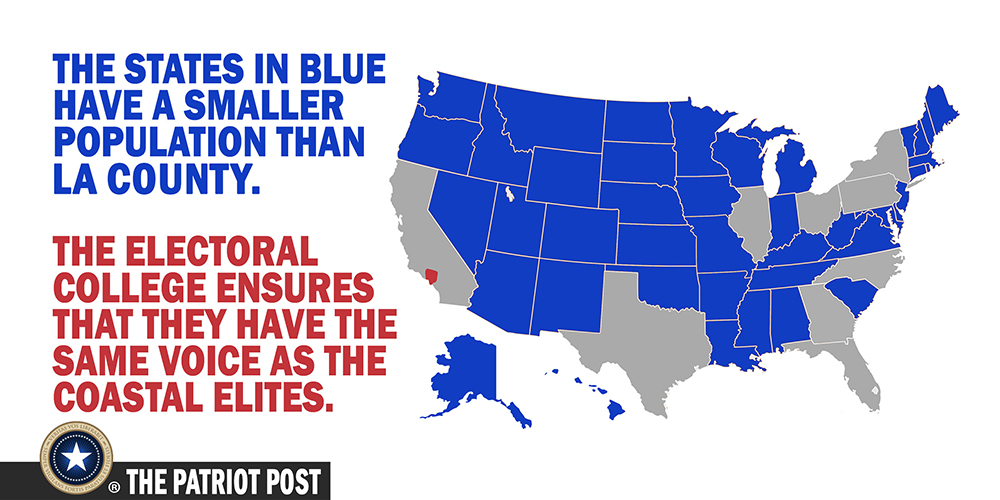
Constitutional Republic vs. Pure Democracy: How the U.S. Election Process Has ChangedAll of this raises the question of what is wrong with democracy, as opposed to a Constitutional Republic? It’s a cliche that democracy is the right of 51 percent of the population to take away the toothbrushes of the other 49. The Constitution provides protections against the tyranny of the majority and one of those protections is against pure democracy.
Indeed, the Senate and Electoral College, two of the last vestiges of the anti-democratic mood that penetrated the country during Revolutionary times, provide protections to rural states to this day. Without either of these, or with a Senate converted into a proportional representation body, as some have suggested, rural states are effectively political serfs for the larger urban centers.
The counter argument presented to this is that “land doesn’t vote,” which is fair enough, but again: America was not conceived as a pure democracy where everyone had an equal say in everything. There are many layers to the onion, many tiers that prevent one group of the population from having too much say over the others. The Electoral College and the Senate allow rural states to have a voice in how the country is run, rather than being totally ruled over by people in urban centers who don’t own guns, can’t grow food, and have never met their neighbors.
It’s not a coincidence that Electoral College abolition is a particular ax ground by the left. The abolition of the Electoral College would allow for sweeping changes in American public policy championed by those currently on the leftward edge of the political spectrum. Do you want to live in a country where, for example, the voters of smaller states like Nevada, New Hampshire and Montana are drowned out by a handful of cities on the coasts? What of medium-sized states with a number of post-industrial cities with their own concerns, just as valid as those of rural America, but entirely separate from the centers of financial, cultural and academic power?
There’s also the small matter of the role that the media plays in shaping public opinion, as well as the role that public works projects and other government spending play in essentially buying votes. Ostensibly “undemocratic” institutions act as brakes on the manipulation of public opinion. Indeed, the Senate was specifically designed as a deliberative body that would “cool the passions” of the masses represented in the lower house, the House of Representatives.

The Primary System as a Laboratory of Democracy

The primary process for nominating presidential candidates represents an excellent example of how pure democracy has produced poorer results than a more managed and directed one.
Most Americans, particularly younger ones, don’t know that prior to the 1970s, the primary contests didn’t mean much. Rather, it was the state party conventions which held greater weight and these were largely managed by party bosses rather than directly influenced by voters. It’s not that this system of backroom wheeling and dealing never produced a total dud or stifled genuine needs for reform – of course it did. However, looking at the roster of candidates produced by this process (i.e., two Roosevelts, a Coolidge, an Eisenhower and a Kennedy), it’s hard to argue with the results.
What was entirely lacking was the current primary process that we have in the United States, which still boasts a very low overall turnout and lasts from approximately the fourth quarter of the year before the election sometimes all the way up until the convention. All told, the Democratic Primary cycle of 2020 had 12 debates planned, with 11 completed and the 12th not happening simply because Joe Biden said he wasn’t going to show up.
The primaries are dominated by highly motivated and often highly ideological voters. This means that a number of highly polarizing figures have made it through the modern primary process, including Barry Goldwater (1964, so a little early) and George McGovern, but also a ton of people who the party in question loved but Americans just plain didn’t like (examples of this being Walter MondaleMichael Dukakis and Mitt Romney). This is because party bosses were much more concerned about someone who could win – and all the patronage that flowed from that – rather than someone who shared their ideological picadillos.
President Eisenhower is perhaps the gold standard of a president annointed by party bosses. Senator Robert Taft, the leading light of the ideologically conservative faction of the party, lost to the choice of the party bosses, General Dwight D. Eisenhower. While historical counterfactuals are hard to tease out, there’s little reason to believe that Senator Taft could have won a general election against President Truman or eventual nominee Senator Adlai Stevenson. This is because, while there was a big thirst to roll back the whole of the New Deal among the hardcore Republican base, there was virtually no taste for it in the American mainstream, which either liked the programs or had learned to live with them. Indeed, it is largely believed that the delegates themselves might have preferred Taft to Eisenhower – but they preferred Eisenhower to losing.
It’s worth noting that in the last two Democratic primaries, party bosses have leaned heavily on the scale against insurgent candidate Bernie Sanders in favor of, respectively, Hillary Clinton and Joe Biden. In contrast, Donald Trump was able to coast to the nomination in 2016 without any significant organized chicanery on the part of the party bosses.
But it’s not just political parties who lose when American presidential candidates are the result of a process catering to a very small niche of the electorate. America loses also, because we are incapable of having substantive, issue-driven debates that address real problems of the American people. Instead, we end up focusing much more on the personalities and cultural differences that divide the two parties – to the detriment of the entire nation.

Election Fraud in the United States
Constitutional Republic vs. Pure Democracy: How the U.S. Election Process Has ChangedThere is dispute as to whether or not there is widespread election fraud in the United States. However, there are three presidential elections that merit a brief discussion in our exploration of the franchise in America.

The 1876 Election

The election of 1876 was so controversial and potentially fraud-ridden that it was the subject of a Congressional Electoral Commission in response to a major Constitutional crisis. There were 20 electoral votes outstanding, with the Democratic candidate one shy of winning, with the 20 outstanding electoral votes all coming from states with potentially massive voter fraud. The Commission was convened by the Democratic House and the Republican Senate, with five members from each body and five from the Supreme Court of the United States.
One of the tricks in question is actually an exploit of pure democracy: In those days, there were no official ballots. Ballots or “tickets” were generally printed up by political parties or their partisans and distributed to the voters. Southern Democrats used ballots with Abraham Lincoln on them in an attempt to fool illiterate voters into voting for their slate.
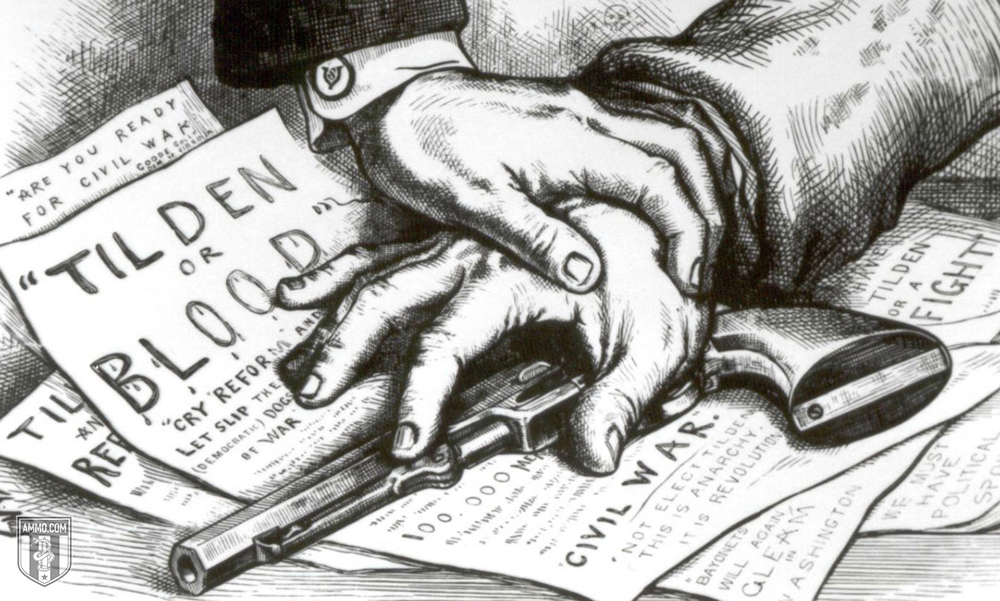
"Tilden or Blood!" was a slogan at the time and Democratic candidate Samuel Tilden’s supporters declared that they had 100,000 men ready to march on the capital and install him as president if need be. A party-line vote of the Electoral Commission gave all the votes to Republican Rutherford B. Hayes, making him president. However, as a concession, the South got the end of Reconstruction and the withdrawal of all remaining federal troops.
Democrats remained unsatisfied, with the House of Representatives going as far to pass a non-binding resolution declaring Tilden the winner. The Electoral Count Act of 1887 made the state legislature the definitive arbiter of who counted as an elector, which was the subject of Bush v. Gore, another controversial election over 100 years later.

The 1960 Election

The 1960 election was disputed as well, but not formally and officially like in 1876. The claim is this: That the Democratic Party used friendly city machines in Dallas and Illinois to win states for John F. Kennedy that he otherwise would not have won – and that would have delivered the presidency to Republican Richard Nixon.
This is not a marginal theory. Senators such as Everett Dirksen and Barry Goldwater have stated that they believe there was fraud in the election. All told, Republicans in 11 states sought to have the vote overturned, including in Illinois and Texas. A special prosecutor charged 650 people with voter fraud, but there were no convictions.
It is unknown to what degree Nixon felt he had been cheated, but he never seriously pursued it, believing it would divide the nation and tarnish the office of the presidency.

The 2000 Election

Finally, there is the 2000 election, where chicanery is alleged to have taken place not at the ballot box, but at the Supreme Court. It was the Supreme Court who stopped the recount under the Equal Protection Clause because they did not approve of how the recount was being carried out. Further, a new standard could not be agreed upon because of the time frame – electors had to be selected by December 12.
This allowed a previous vote count certified by Secretary of State Katherine Harris (a Republican and Bush family ally) to stand.
Here the question was not about whether or not someone was ballot-box stuffing. No one has seriously or credibly proposed this. What was in question is how the votes were counted. This calls to mind an apocryphal quote often attributed to Soviet dictator Joseph Stalin:
“The people who cast the votes decide nothing. The people who count the votes decide everything."
Several have written that if a statewide recount were done, rather than a county-based one, that it was Vice President Al Gore who would have won. But the question here is what was the best way to count the votes. And unsurprisingly, partisans of both parties prefer the method resulting in their candidate winning.

Beyond the Theory: Why Pure Democracy Is Bad In Its Execution

Once the notion of a universal franchise enters the public vernacular, there is then no limit on who should be included. Andrew Yang became the first major party presidential candidate to endorse lowering the voting age to 16, but others have endorsed removing age requirements for voting entirely. Indeed, there is an entire current of thought that says that citizenship shouldn’t be a requirement (it isn’t in some municipal elections) or even that the entire world should be allowed a say in who becomes the President of the United States.
While these might all sound like ridiculous proposals – and we agree that they are – they are the thin edge of the wedge, the tip of the spear that will eventually introduce this kind of discourse into the political mainstream and perhaps much sooner than anyone thinks. If the only criteria for who gets to vote is that you are “affected by government policy” or some such and thus entitled to a say, why not let the entire populations of France and Bangladesh and China have a vote? There is a logic to universal suffrage that does not end with America’s adult population or even at its borders.
Consider the fight against voter ID laws in the United States. When one accepts that voting is a universal right, it makes perfect sense that having or not having an ID shouldn’t be an impediment to exercising that right. A lack of voter ID laws has been tied to voter fraud. But perhaps more disturbing is the growing practice of ballot harvesting.

Ballot Harvesting
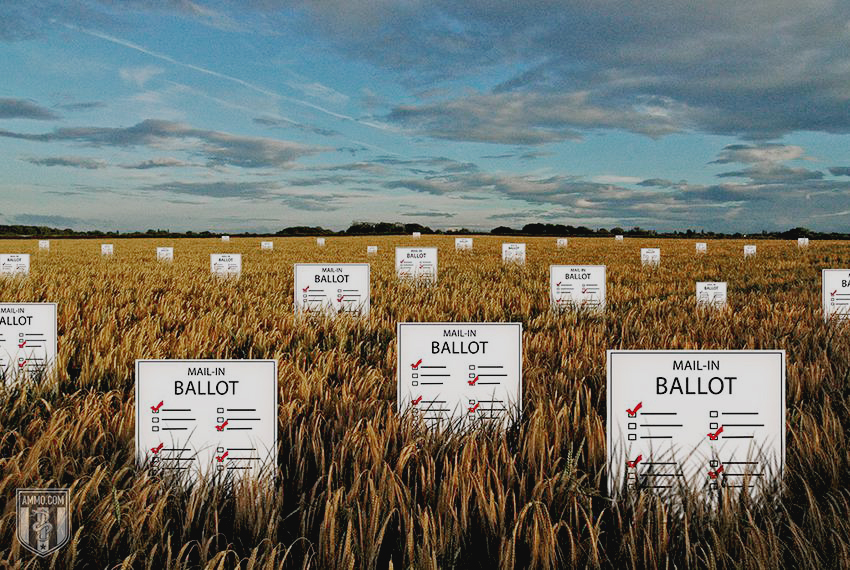
Constitutional Republic vs. Pure Democracy: How the U.S. Election Process Has ChangedThe Democratic Party likes ballot harvesting so much that they tried to insert it into the stimulus and relief bill targeted at people suffering from the effects of the Wuhan Coronavirus outbreak of 2020. Put simply, this is when paper ballots are collected by intermediaries between the state and the voter, then delivered en masse. If this sounds like it’s a ripe place for voter fraud to happen, that’s because it is. Ballot harvesting played a role in the do-over of the 2019 North Carolina election, where Democrats were, perhaps for the first time ever, deeply concerned with the specter of voter fraud.
Orange County, California, was home to a whopping quarter million ballots delivered on Election Day alone. In practice, ballot harvesters go around collecting ballots for people who vote for the candidate they want to win. In the case of North Carolina, there were allegations that ballots had been discarded because people voted for the “wrong” candidate.
In the wake of the Wuhan Coronavirus outbreak, there has been a push – mostly from Democrats – to offer mail-in ballots. These are different from absentee ballots, which are sent out to specific voters on a by-request basis. Compare this with the push for mass mail-in voting: This is just printing up a ton of ballots, sending them out and letting everyone mail them in. There are few, if any, protections in place for preventing people from voting twice, preventing non-registered voters from voting, or preventing illegal aliens from voting. For every person who votes that shouldn’t, a legal voter has their vote cancelled out or nullified.
There’s not much of a way to verify and track this process to ensure that everyone who votes is having their vote counted. But again, it is very much in keeping with the logic of “one man, one vote.” Those who espouse the ideology of a pure democracy are always looking for ways to make it easier for people to vote.
Perhaps, not coincidentally, making it easier for people to vote also opens up the door to electoral fraud.
And this is really the crux of the matter when it comes down to pure democracy: The transition to a purer democracy has coincided with greater influence among unofficial kingmakers who control the process while also consolidating greater power in Washington, D.C. In practice, this has meant favoring a bureaucratic elite who effectively act as unelected legislators. Most of the regulations put in place by the alphabet soup of federal agencies aren’t there by statute, but are in fact part of powers delegated to them by the legislature who have abdicated their legislative authority.
What’s more, these unofficial kingmakers are often shadowy figures whose names (to say nothing of their intentions) are mostly unknown. These are not the traditional party bosses who were, in a sense, beholden to their people in the form of having to provide patronage and pork and other tangible results. Rather the new kingmakers of our pure democracy are the mass media, party activists and others with no skin in the game and little in the way of public accountability. Their angle is one entirely of self-interest and not to the broader body politic, to say nothing of future generations.
-- Political Pistachio Conservative News and Commentary

Temecula Constitution Class: In the Beginning

We have returned, and our last class was lesson one, so I decided we will do a restart.  It's like a NASCAR race.  Things didn't work out with the first firing of the gun to start the race, so we will try again.

That said, I have been made aware that at 7:00 pm a new Bible Study has emerged at 412 Murrieta on Wednesday Nights, and some of the students are going to be attending it.  I have wrestled long and hard over what to do, and finally after discussions with a few folks late last night I decided we will bump the class forward a half hour.  So, be aware of the time change...

We will begin at 5:30 pm, and try to wrap up by 6:30 pm.

Some have asked, why not change the day of the week?  In all honesty, every other day of the week has something else going on that I participate in, be it Republican Meetings, Tea Party Meetings, and so forth.

So, see you at 5:30 pm at the Republican HQ at 28120 Jefferson Ave. in Temecula (right next to the tattoo shop).

Temecula Constitution Class
Wednesdays 5:30 pm
GOP HQ
28120 Jefferson Ave.
Temecula, CA  

Constitution Class Handout
Instructor: Douglas V. Gibbs
www.politicalpistachio.com
www.douglasvgibbs.com
www.constitutionassociation.com
Lesson 01
We the People of the United States
An Introduction to the Preamble
We the People
We the People of the United States, in Order to form a more perfect Union, establish Justice, insure domestic Tranquility, provide for the common defence, promote the general Welfare, and secure the Blessings of Liberty to ourselves and our Posterity, do ordain and establish this Constitution for the United States of America.
            History
The formal version of the Magna Carta in England was issued on June 19, 1215. There was a minor change in the new document, when the final provision was drafted, replacing the term "any baron" with "any freeman" in stipulating to whom the provisions applied. The term would eventually include all Englishmen. The final version's applicability to all members of the English Society served as a starting point for the Constitution's Preamble, where "any freeman" was changed once again, but this time to the first three words of the American document: "We the People."
The English Colonists developed legal codes largely incorporating liberties guaranteed by the Magna Carta and the 1689 English Bill of Rights. Though the education levels of the colonists varied, and few could afford legal training in England, they were familiar with English common law. During one parliamentary debate in the late 18th century, Edmund Burke observed, "In no country, perhaps in the world, is law so general a study."
James Madison and Thomas Jefferson drew inspiration from the doctrines of the British constitution, or in what were called English liberties.
Unlike the Spanish Colonies, which were conquered land ruled over by the Spanish Conquistadors, and authoritarian governors, the English Colonies were granted by charter. Rather than bear the burden of empire, which, as Spain discovered, could be expensive, and taxing on a nation's armed forces, the English Crown offered the lands along the Atlantic Coast to investors, entrepreneurs, and families seeking a new start. In the northern colonies, the colonists sought religious freedom. The Pilgrims did not want to keep their membership in the Church of England. As separatists, the Pilgrims organized their worship independently, colonizing north of the Puritans at Plymouth Rock.
The English Colonies enjoyed autonomy that the Spanish Colonies did not. To survive in the Spanish Colonies, the colonist exhibited a warrior spirit, conquering the lands and the people who stood in the way, forcing the captured natives into slave labor and marriage for the purpose of accomplishing the tasks necessary for survival, while also being heavily dependent upon supplies from the homeland. The English Colonies were expected to survive by living off the land. They were families, indentured servants, and seekers of fortune. They were forced to be self-reliant, personally responsible, and hard working, in order to survive. The English Colonists did not attempt to conquer the natives as the Spanish did, but worked with them, making treaties with the Native Americans, because they needed the native population's help in order to survive. In the English Colonies, freedom was a necessary component of survival, and after failing under communitarianism, the colonists found that a free market system, where colonists kept more of what they worked for, and had the option to trade goods in an open market, worked best for the burgeoning society.
In English America, freemen adopted the best of the English system, while adapting it as necessary to the new circumstances in the colonies. The English Colonies was a place where a person could rise by merit, not by birth. The thirteen colonies was a place where men could voice their opinions and actively share in self-government. When the British Crown challenged these beliefs, turning to the colonies as a source of revenue to help alleviate the Crown's substantial debts, and the growing expense of keeping troops on American soil, the colonists questioned the government in Britain, challenging the actions of Parliament, arguing that without consent or direct representation in Parliament, the acts by the motherland were "taxation without representation," and an act of tyranny against the free Englishmen of the colonies.
The influence of the Magna Carta, and the demand for liberty, existed along the Atlantic Coast long before the War of Independence. As John Adams later wrote to Thomas Jefferson, "The Revolution was in the minds of the people, and this was effected, from 1760 to 1775, in the course of 15 years before a drop of blood was shed at Lexington."
The Americans knew their rights, and they were willing to fight for them. The seal adopted by Massachusetts on the eve of the Revolution summed up the mood. The image was of a militiaman with sword in one hand, and the Magna Carta in the other.
When it was time to form a new government, embodied in a written social contract we now know as the Constitution of the United States, the founders determined that like England under the Magna Carta, the government must be limited by subjecting it to the rule of law. The Constitution, once ratified by the States, became the law of the land. The document serves as a written standard where the authority emanates from the people, not from any governmental body. Pursuant to the Constitution, no man, not even the country's leader, was considered to be above the law. The rule of law based on the philosophy of the Laws of Nature and of Nature's God was the basis of constitutional thought in the United States in 1787.
"A government of laws, and not of men." - John Adams
Elder statesman Benjamin Franklin strolled across a grassy lawn from Independence Hall in Philadelphia, after the conclusion of the Federal Convention of 1787, when a woman in a bonnet approached him, asking, "Sir, what have you given us?"
"A republic," Dr. Franklin replied. "If you can keep it."
The new government in the fledgling United States was considered to be one that was doomed to fail. Europeans scoffed at the American experiment in self-government. The Old World argued that without the hand of a divinely appointed, wise, ruling monarch in place to guide society, a culture could not succeed. The Grand Experiment was a waste of time, and it would not be long before the rebellious, starving, treasonous, and petulant, English colonists came crawling back to the British Crown, begging to be readmitted to the empire.
In a society with no government, people have no freedom. In a society with too much government, people have no freedom.
Without government there is no law, and without law there are no enforcers of the law. This kind of system is called an anarchy, which is a transitional form of government. In an anarchy, there is no freedom because the citizens must constantly protect their property, and their lives.
With government in place, there are laws in place. When there are laws in place, it is necessary to hire enforcers of the law, such as a police force. A society with a government in place can create an environment of freedom that allows citizens the ability to leave their property and engage in activities away from their homes.
Tyranny through a unitary state dominates the pages of history. Tyrannical governments obtain their power through violence, and bloodshed in a complete disregard for authorities granted, justice, or the rule of law. To maintain their power, tyrants use violence and bloodshed. When tyrannies are finally toppled, the path to dislodging tyrannies normally includes violence and bloodshed.
Violence and death are the common results of powerful central governments with dominant rulers.
Dictators do not normally reveal their plans of tyranny during their rise to power, for the people would never have allowed them to become their leaders if they knew this kind of violence was in their future. Tyrannical leaders render legislative bodies irrelevant, demoting them to nothing more than a consultative assembly.
In history, tyranny is the rule, and liberty is the exception. Governments that protect the freedoms of the people, and respect the rights of their citizens, are a rare occurrence. Freedom requires the citizens to be informed and involved. With freedom comes responsibility.
An educated society begins by teaching the younger generations the principles of liberty, and to encourage them to be involved in civic activities, and local government. The founders understood we need government, but a limited government was required to protect the rights and property of the citizens. However, because of human nature, the founders realized that without making sure the people remained educated about the system they had established, a downward spiral into despotism and tyranny was inevitable.
The Declaration of Independence was approved by the Continental Congress on July 4, 1776, and outlined the reasons why the colonies were seeking independence from Great Britain. The founding document declares that it is the right of the people to alter or abolish their government should it become destructive. It also states these truths are self-evident, and that "all men are created equal, that they are endowed by their Creator with certain unalienable rights, that among these are life, liberty, and the pursuit of happiness."
The document penned by Thomas Jefferson includes a list of grievances, most of which are also iterated in the U.S. Constitution. The Declaration calls for fair representation, encourages immigration, calls for a judiciary that is separated from the will of the central leadership, calls for a stop to the presence of a standing army, demands that Great Britain stop the quartering of troops in the houses of the citizens, demands fair trials, and calls for due process, free trade, fair taxation, a protection of rights, and for the Crown to hear the redress of grievances by the colonists.
A key aspect of the Declaration of Independence reveals itself in the final sentence of the document. The call for independence ends with the incredible statement, "And for the support of this Declaration, with a firm reliance on the protection of divine Providence, we mutually pledge to each other our Lives, our Fortunes and our sacred Honor."
Political Spectrum
In the battle of Left versus Right, it is important to understand what it all means in the first place. Like-minded individuals naturally tend to gather together when a theater of opinion erupts. Congregating in such a manner, creating political parties, is a part of our human nature. Houses, or chambers, of government are no different. Members of the political assembly who support similar agendas sit together, much in the way social allies tend to hang out together at a dinner party. The classification of "left" and "right" grew out of the tendency of people to group together on one side, or the other.
The early definition of "left" and "right" was different than in today's American Society. Among the most commonly known split between the left and the right in a political assembly occurred in France before the French Revolution. Members of the National Assembly sat on the right or the left of the hall depending on their level of political support in regards to the ruling monarchy. Those in support of the monarchy, and the religious elements that came with the reigning government, would sit on the right. The people on the right were defined as being those holding traditional interests in line with the Church and the monarchy, believing the king ruled by divine right, and that Catholicism must continue to be the state religion, and therefore continue to be a strong influence on governance. The people who sat on the right side of the assembly believed that the Church had a vested interest in the political system, and sought to preserve that system.
Those who sat on the left side of the hall in France during the period preceding the French Revolution did so in support of "enlightenment," which was considered to be in the interests of rationalism and secularism. The left used secular elements to challenge the Church's long-held influence over government, fostering nationalism among its allies, and promoting hope in constructing and shaping the political community. The left desired to change government by overthrowing the Church and the aristocracy by promoting secularism and nationalism. The planners of this glorious new "Enlightened" government became the leaders of France after the French Revolution, orchestrating a Reign of Terror, which was a period of chaos during which thousands were guillotined for being politically incorrect.
The radicals within this new government saw the Catholic Church as the enemy while promoting its Cult of Reason. Like with the monarchy before them, however, it became clear that to control the political and social upheaval, the government in place must also become tyrannical in their own right. Under the rule of statism, France remained a nation unable to cultivate liberty, and one that remained under the iron fist of a dictatorial government. For many, this was no surprise. Some of the planners of the change of the form of government in France knew that in order to keep order they would need to "treat the people as cattle."
The French National Assembly established a constitutional monarchy and adopted a new constitution in 1791 that created a Legislative Assembly. The political assembly, as with any other political body, rapidly divided into factions opposing each other. The three factions that formed in the new French Legislative Assembly were the radicals (liberals), moderates (centrists) and conservatives. The radicals (liberals) sat in the left section of the assembly hall, the conservatives sat on the right, and the moderates sat in the center section. Their political identities have some similarities to political movements today in the United States, and had little in common with the pre-revolution arrangement that emphasized itself more on monarchy and religion.
America is much younger than the European nations, and never had a landlord class of titled nobles. In fact, the Constitution specifically prohibits such a system. The Founding Fathers desired to break away from European traditions as much as possible, even abandoning much of British Common Law when defining citizenship. To be a British Subject the rules were weak, and divided loyalties ran rampant throughout the British Empire. The United States as a nation could not tolerate divided loyalties, and placed a stronger standard of natural born citizenship upon the President in order to eliminate the opportunity for the executor of the American Form of Government to harbor divided loyalties between the United States of America, and any other nation. That way, the new American government could break completely free of any European influence, and forge itself into a Republic independent from British influence, and in fact, the authoritarian nature of Europe as a whole.
The political landscape of the United States of America, since there never was a class of nobles, was simple in the young nation. Either you were a Federalist, an anti-Federalist, or somewhere in between. In other words, you believed in a stronger centralized federal government, you believed that the federal role in government should be limited greatly, or you found yourself somewhere between the two political beliefs.
Unlike the Europeans, royalty and religion played no role in determining the nature of American political philosophies. Nearly all of the early American Politicians were deeply religious men, but the political spectrum did not separate factions along religious lines. God played a major role in the principle foundation of the nation, but the founding fathers also determined that no religion could ever take an official role in government. In other words, the establishment of any religion as the official religion of the United States was forbidden. However, the freedom to practice one's religion was not to be infringed upon. Almost all of the signers of the Declaration of Independence were either clergy, or highly involved in their church. 27 of the 56 signers had Christian seminary degrees. The founding fathers fervently prayed in Congress.
Benjamin Franklin is widely regarded to be among the least religious of the founding fathers. However, his speech given to Congress on June 28, 1787 asking that Congress have a prayer every morning before conducting business was overtly religious in nature. Despite modern assumptions, there was not a political battle between The Church and the secularists during the founding of the United States of America.
From the newer models of government in France, and America, the definition of the Political Spectrum changed, becoming more about the level of control of government over a society, rather than the presence of a monarchy, or established church. Zero percent of government intrusion on the lives of the people inhabits the far right of the current political spectrum, which is a condition known as anarchy. 100% governmental control inhabits the far left extremity of the Political Spectrum, or a totalitarian government. The American form of government, or a Constitutional Republic that operates under the rule of law, is at the center of the political spectrum.
Most of the current forms of government present in today's international political arena reside on the left side of the Political Spectrum, drawing their foundations from socialist principles. Socialism is authoritarian. Socialism claims to seek to overthrow the Church and aristocracy by promoting atheism and nationalism, much like the enlightened planners of the French Revolution, only replacing the government they thought to be a tyranny with a tyranny of their own. In Russia, the rise of socialism held the basic tenet of replacing the individual's commitment to God with a commitment to love and serve a collective society ruled by an elite few.
When one examines the communist society, which resides on the left side of the Political Spectrum, one finds that if society was ruled over by an equally powerful religious theocracy, the basic governmental elements of the ruling doctrine are the same, and just as tyrannical. Therefore, a controlling government based on religion is no different than an atheistic system of communism. Either way, the form of governance is based on a centralized control over the people, and limits on personal individualism, and freedoms.
Economically, leftism encourages increased government involvement with the instruments that regulate the economy. Under a leftist economic system, such as in the communist model, the government seizes control of the industries, eliminating private ownership. In the fascist model, however, the authoritarian political entity engages in corporatism, allowing the private enterprises to remain private, yet bundled together in a uniting strength under authoritarian government rule. Because fascism (from Italian fascismo, Benito Mussolini's authoritarian political movement in Italy 1922 to 1943) was created to be an adverse reaction to the apparent economic failure of Marxism, and labeled itself as the opposite of communism, fascism is often referred to as being right-wing, and ultra-conservative. If you break down the political structure of fascism, however, it becomes apparent that defining fascism as being on the right side of the political spectrum is problematic. Like socialism, fascism exalts the group above the individual (in fascist states often the nation or race is exalted above the identity of the individual). Like other leftist systems, fascism also calls for a separation of church and state, a national civilian army, and progressive taxation. One element of fascism some may argue as being right-wing is the fact that fascism seeks to eliminate labor unions for co-ops. But the co-operatives, in a fascist state, are controlled by the government, and therefore become more leftist than the system before. Though fascism, during the early twentieth century, claimed to be anti-communist, the National Socialism aspect of the ideology places fascism on the left side of the Political Spectrum.
Ultimately, the true definition of the Political Spectrum is dependent upon how government interacts with society. Increased government intrusion moves needle on the spectrum to the left. Increasing limitations on government intrusion moves the needle to the right. In both cases, the extreme of totalitarianism, or anarchy, are equally dangerous. Ultimately, most forms of government, despite the promise of fairness, are often only precursors to another form of government. The Founding Fathers realized this, recognizing that the only form of government that both limits the powers of the federal government, while still giving it adequate authority to protect and preserve State Sovereignty, is a Constitutional Republic. They knew that if you pursue leftism too far, an authoritarian government would rise from the movement. If government was limited too much, and the government did not have enough power to enforce law, an authoritarian government would also rise to fill the void.
            The Preamble
We the People of the United States, in Order to form a more perfect Union, establish Justice, insure domestic Tranquility, provide for the common defence, promote the general Welfare, and secure the Blessings of Liberty to ourselves and our Posterity, do ordain and establish this Constitution for the United States of America.
The Preamble is the introduction of the U.S. Constitution. The opening paragraph of the founding document holds no legal authority. The Preamble serves to establish who is granting the authority to create a new federal government, and the reasons for the decision. We The People of the United States are the grantors. In other words, the States, which were the embodiment of the people, were creating the federal government, and granting authorities to it so that it may function in a manner necessary to protect, promote, and preserve the union of States. The concept became known as federalism.
The Preamble is designed much like a permission form the doctor's office may present to you to sign, giving the doctor the authority to perform necessary procedures on your body in order to make you well. The form begins with your name (I, patient's name), and then limits the doctor to only the procedures necessary to make you well. The doctor, if he or she believes additional procedures may be necessary, must ask for your permission before performing the additional procedures that are not granted by your original agreement with them.
Like the form in the doctor's office, the Preamble begins with who is granting the authorities. "We the People of the United States" are the grantors of the authorities given to the new federal government. The people, through their States, allow the federal government to exist, and to perform the procedures expressly granted in the United States Constitution.
If a homeowner hires a contractor to add a room to their house, a contract is created between the homeowner, and the company hired to do the work. The contract establishes the granted authorities to the construction company regarding the room addition, listing the materials and labor necessary and proper to carry out that task. If, later, after the work begins, the homeowner observes the workers tending to the garden, and mowing the lawn, the homeowner would be angry because lawn maintenance was not among the authorities granted to the contractor hired to provide the service of adding a room to the house. In the same way, through the Constitution, the federal government has been granted a list of authorities that are necessary and proper for it to carry out the tasks vested in it. The tasks directly relate to protecting and preserving the union, while also respecting and promoting State Sovereignty. The federal government's authorities encompass only the external issues necessary to protect the union, and the sovereignty of the States. Internal issues are not granted to the federal government. Local issues are reserved to the local governments, such as the States, counties, and cities.
The first three words of the Preamble, "We the People," often lead people to believe that we are a democracy. Taken in context, the first part of the Preamble is not only "We the People," but "We the People of the United States." In the context of original intent, "the people of these States that are united have come together to establish this contract for the following reasons."
The words "United States" appear often in the U.S. Constitution. When those words appear in the text of the Constitution, they mean one of two things. Either, "United States" is a reference to the new federal government, or United States means "these states that are united." In the case of the Preamble, both definitions are used. As we notice the first time united States appears in the Declaration of Independence, "united" is not capitalized. Failing to capitalize "united" in the Declaration of Independence was a reflection of the common opinion of the people of that era. America was not a nationalistic country dominated by a powerful government, but a union of States that are sovereign, autonomous, and individual - like the people. We the People are the individual parts of their States, and the States are individual parts of the union.
Early Americans saw the United States in the plural, rather than as a singular nationalistic entity. The people were citizens of their States first, but realized that the States must be united to survive. The individual States would only be safe if they all worked together as a united country. To ensure the union was protected they proposed forming a central government through a social contract called the United States Constitution. This contract to grant limited authorities to a federal government was designed to ensure that the federal government remained limited so as to not infringe on the individual rights of the sovereign States, and the people who resided in those States.
A limited government is the essence of liberty.
The reasons listed in the Preamble for forming a new government were "In Order to form a more perfect Union, establish Justice, insure domestic Tranquility, provide for the common defense, promote the general Welfare, and secure the Blessings of Liberty to ourselves and our Posterity." In line with classical writing standards, these reasons were listed in order of importance.
The most important reason for the formation of the federal government, the main purpose for the creation of the U.S. Constitution, was "in Order to form a more perfect Union." A union already existed under the Articles of Confederation. A confederation, however, is a weak form of government where nearly all of the power remains with the individual members. A confederation is an association of sovereign member states that, by treaty, or other agreement, have delegated some of their powers to a common institution in order to coordinate policies, without constituting a new state on top of the member states. The government under the Articles of Confederation was formed hastily during the Revolutionary War, and as revealed by Shays' Rebellion, proved to be too weak to protect the union not only from threats beyond our shores, but insurrection from within the country. The founders realized that they needed to form a more perfect union, one with more authorities, while still remaining fairly limited in its power and scope. The realization that the Articles of Confederation were too weak, and either needed to be fixed, or replaced, was first discussed in delegation during the Annapolis Convention in 1786. During that meeting, the attending State delegates decided to meet again in May of 1787 in a convention of all States, which became the Federal Convention of 1787.
Under the Articles of Confederation, the central government was as weak as a lamb. What America needed was a central government with the strength of a lion. The problem with lions, however, is that they can kill you if not restrained. So, the Founding Fathers had to figure out a way to create a lion strong enough to deal with the external issues, and conflict between the States, while restraining that lion in such a way that the people living under it were safe from its potential tyranny. The lion is the federal government, and the chains and restraints of a set standard that protects We the People from that lion is the United States Constitution.
In the Constitution, the authorities granted to the federal government are limited to protecting, preserving, or promoting the union. The federal government, through the express powers granted in the Constitution, was granted authorities including, but not limited to, maintaining an army and navy in order to protect the union, to collect taxes in order to pay for that military and the other necessary functions created for the purpose of preserving the union, to regulate commerce by acting as a mediator between the States so that the flow of commerce flows regularly and in good order so as to encourage a growing economy for the union, establish a uniform rule of naturalization for the purpose of ensuring the union grows through legal immigration, and to establish post offices so that the many parts of the union may remain in contact with each other. The federal government was created for the sake of the issues related to the union. The federal government was not created to manage local issues that have nothing to do with the union, and everything to do with the unique cultures and societal needs of the local communities.
The second reason listed in The Preamble for the creation of the federal government through the ratification of the U.S. Constitution were to "establish Justice." Note that the word "establish" is normally used in situations where whatever is being established never previously existed. The word "establish" being used in the Preamble, then, leads us to believe that there was no justice prior to the writing of the founding document. However, justice systems already existed in each of the States, through State court systems. Therefore, the U.S. Constitution was not written to establish justice in the States, but to establish justice at the federal level where a judicial system had not previously existed. The language used in the Constitution, in this case, provides us with a clue that the original intent of the Founding Fathers was for the Constitution to apply only to the federal government, unless it specifically states otherwise.
Though "establish Justice" is listed second in the list of reasons for creating the federal government, we must not confuse "importance" with "power." To establish justice was a very important reason for creating a federal government, but the federal court system, for fear of it becoming a powerful judicial oligarchy, was also greatly limited. During the debates of the Constitutional Convention in 1787, there was actually a consideration to not establish a federal court system. The delegates realized that tyranny easily flows through an activist judiciary. The rule of law could be easily compromised by a judicial branch not willing to abide by the original intent of the U.S. Constitution, or poisoned by political ideology. For this reason, the powers of the judicial branch are greatly limited by the Constitution. We will go into more detail regarding those limitations when we get to Article III, and the 11th Amendment.
The first two reasons for the writing of the U.S. Constitution, according to the Preamble, were to form a more perfect union through the formation of a federal government, and to establish justice by creating a federal judicial system. Those primary goals reveal to us that the Constitution was not written to grant powers to the States, but for the purpose of creating, yet limiting, a newly formed federal government, which was designed to serve the States by protecting them, and preserving the union they enjoyed. Before the States delegated some of their own powers to the federal government through the Constitution, all of those powers belonged to the States - a political condition known as Original Authority. The States, however, only granted "some" of their powers to the federal government, retaining most of the powers for themselves.
The U.S. Constitution, and all language within the document, is directed to the federal government, not to the States, unless specifically indicated otherwise. This is because the States essentially "hired" the federal government to protect and preserve the union. The contract that authorizes the federal government to exist and receive the authorities from the States is the U.S. Constitution. Therefore, it would not be reasonable to assume that the provisions of the Constitution are to be applied to the States as much as it would not be logical to believe that an agreement between you and your doctor tells you what you can and can't do regarding the procedures that are about to be performed on you. The agreement with the doctor is specifically designed to tell the doctor what procedures are allowed, just as the Constitution is specifically designed to tell the federal government what authorities it is allowed to have in order to protect, preserve, and promote the union. In that contract with the doctor there may be instructions that tell you what not to do so as to not undermine healing, such as submersing oneself in water before a wound is fully healed. The same is true in the Constitution. There is a section, Article I, Section 10, that tells the States what they are prohibited from doing. These prohibitions were necessary to ensure the States did not interfere with federal functions.
Since it is We The People of the United States who granted the federal government its powers, that means it is the people's responsibility, through the States, responsibility to ensure the federal government acts in a constitutional manner. The Constitution is nothing more than ink and paper if we don't fight for it.
The union, at the time of the writing of the Constitution, was fragile. The States, as colonies, or as individual states shortly after the American Revolution, did not always coexist in a mutually beneficial manner. The States enjoyed their own unique cultures, religions, and laws. The States clashed over territory, commerce, and a variety of other issues that often included disputed legal issues and definitions. The States were much like siblings, fighting over everything under the sun; but when it came down to brass tacks, they were united when it came to defending each other.
The bickering between the States created an atmosphere that placed the cohesion of the union at risk. Therefore, when it came to creating a more perfect union, it was understood by the framers that the federal government would have to "insure domestic Tranquility" and to "promote the general Welfare."
The federal government was expected to ensure there was tranquility between the States by acting as a mediator in disputes. Part of that task by the federal government was to also promote the general welfare of the republic. In other words, the federal government was tasked with making sure the squabbles were properly resolved, while also protecting the union, so that the welfare of the union would not be in jeopardy.
The term general Welfare, as it is presented in the Preamble, is capitalized in a curious manner. Welfare is capitalized, but the word "general" is not. Capitalization in the Constitution was often used for the purpose of emphasis. With that tendency as our guide, we recognize that "Welfare" was the key component when these two words were presented in the Preamble. The Founding Fathers were seeking "Welfare" with a capital "W." The founders tasked the federal government with the duty of ensuring there was Welfare in the nation in a general manner. Or, you could say that they wanted the atmosphere in general to be one of "Welfare," or "all's well," hence, the reason general is not capitalized, and Welfare is, in the Preamble.
Tucked between "insure domestic Tranquility" and "promote the general Welfare" is the phrase: "provide for the common defence." The placement of this phrase in The Preamble reveals that providing for the common defense was almost as important as ensuring peaceful cooperation between the States, and slightly more important than promoting the general Welfare of the republic (and a necessary part of ensuring the general Welfare).
The need to provide for the common defense, one may note, was not listed first in The Preamble as one of the reasons for the creation of the federal government. The Founding Fathers, though they recognized the importance of the federal government to field a military force, as realized from the failure of the government to put down insurrection during Shays' Rebellion under the Articles of Confederation, did not list the need to provide for the common defense at the beginning of the Preamble because a country that places too much importance on a military is doomed to become a police state. Defending this nation was not placed at the bottom of the list of reasons for the writing of the Constitution, either, because a nation that refuses to defend itself ultimately becomes a conquered entity that is subject to the authority of a foreign government. Despite the fear of a powerful military that could be used against the people and the States, providing for the common defense was still indeed one of the primary reasons for creating the federal government in the first place. That is why "provide for the common defence" is listed in the Preamble within the central depths of the body of the paragraph.
The final reason for the writing of the Constitution was to "secure the Blessings of Liberty to ourselves and our Posterity." The presence of the word "Blessings" reminds us that the Founding Father's grateful spirit recognized that the result of the American Revolution, and the inspiration for the new federal government, could have only come from the favors of Divine Providence. Liberty, remember, is one of the unalienable rights listed in the Declaration of Independence that has been given to us by The Creator. In fact, that is one of the foundational beliefs of the original intent behind the creation of the federal government. Our rights are granted to us by God, not by government, for if our rights are granted to us by government, government would then be able to take those rights away. This idea of God-granted rights is based on a concept called Natural Law penned by John Locke during the 1600s. In the Declaration of Independence, it is referred to as, "Laws of Nature and of Nature's God." Natural Law is the unchanging moral principles regarded as a basis for all human conduct, which is observable law we participate in as related to our natural existence.
The U.S. Constitution was not solely written only to protect our natural rights, liberty, and property. Protecting our rights, liberty, and property are among the chief reasons the Constitution was written in the manner that it was, and protecting those natural rights are predictable byproducts when the Constitution is being followed by the government, but those are not the only reasons for the perceived need to compose the founding document, or for the creation of the federal government.
As indicated in the Preamble, the primary reason for the Constitution was "in Order to form a more perfect Union." However, the very formation of that union, and devising a governmental system to protect, preserve and promote that union, was not exclusively for the sake of the union, either. The ultimately desire was to protect the sovereignty of each component of that union - The States. The framers understood that by creating a federal government, the potential for the governmental system to become a tyranny was unleashed. Therefore, in order to protect the rights, liberty and property of the people (more specifically to "secure the Blessings of Liberty to ourselves and our Posterity"), the federal government needed to be limited in its authorities by the rule of law. The law of the land in which the governmental system is limited to, in the case of the United States, is the U.S. Constitution, for the sake of protecting the individuality of the States, and We the People.
Terms:
Confederation: A confederation is an association of sovereign member states that, by treaty or other agreement, have delegated some of their powers to a common institution in order to coordinate policies, without constituting a new state on top of the member states.
English Bill of Rights: The Declaration of Rights in 1689, following the relatively bloodless "Glorious Revolution" of 1688, reasserting Protestant influence in England, and establishing a written declaration based on the belief that rights are granted by God, limiting the power of the king, and guaranteeing individual rights in writing. At its core, the system of government based on the English Bill of Rights, and the Magna Carta, holds as its philosophy that government is to serve the people, not the other way around.
Federalism: Government in which the central government's power and authority is limited by local government units, and where each unit is delegated a sphere of power and authority only it can exercise, while other powers must be shared. The term federalism comes from the Latin root foedus, which means "formal agreement or covenant." It includes the interrelationships between the states as well as between the states and the federal government.
Magna Carta: The "Great Charter" of English Liberties, forced from King John by the English barons at Runnymede, June 15, 1215. A fundamental constitution, or law guaranteeing rights.
Unalienable Rights: Incapable of being alienated, that is, sold and transferred. You can not surrender, sell or transfer unalienable rights, they are a gift from the Creator to the individual and can not under any circumstances be surrendered or taken. All individual's have unalienable rights.
Questions for Discussion:
1. How might the United States be different if the Magna Carta, or the Glorious Revolution, had never taken place?
2. Many of us were taught to memorize the Preamble in school, others remember it because of the School House Rock cartoon on Saturday mornings, but growing up how many times were we taught what it means?
3. Federalism, or the belief in a central government limited by the authorities granted to it in the Constitution, began as a wonderful idea. The members of the "Federalist Party," however, were not satisfied, and desired the federal government to have more authorities than it was granted. Why do you think this is true?
4. Why did the Founding Fathers only desire the federal government to be granted powers that regarded the union, and not authorities in regards to other issues?
4. The judicial branch was supposed to be the weakest of the three branches. Why do you think the Founding Fathers wanted to limit the judiciary to such an extent?
5. One of the founding principles is that our unalienable rights are given to us by the Creator. Is it a coincidence that historically most authoritarian governments that sought to take away the rights of the individual did it either by taking control of the church, or by rejecting religion/the existence of God?
6. At what point does a government take "provide for the common defense" too far?
Resources:
James L. Roark, Michael P. Johnson, Patricia Cline Cohen, Sarah Stage, Alan Lawson, and Susan M. Hartmann, The American Promise: A History of the United States; Boston: Bedford/St. Martin's (2009).
James Madison, Federalist No. 41: General View of the Powers Conferred by The Constitution, http://www.constitution.org/fed/federa41.htm
John L. Hancock, Liberty Inherited: The Untold Story of America's Exceptionalism; Charleston: Liberty Lane Media (2011)
Joseph Andrews, A Guide for Learning and Teaching The Declaration of Independence and The U.S. Constitution - Learning from the Original Texts Using Classical Learning Methods of the Founders; San Marcos: The Center for Teaching the Constitution (2010).
Larry Schweikart and Michael Allen, A Patriot's History of the United States; New York: Sentinel (2004).
Madison's Notes on the Constitutional Convention, Avalon Project, Yale University: http://avalon.law.yale.edu/subject_menus/debcont.asp
Philip B. Kurland and Ralph Lerner, The Founder's Constitution - Volume Two - Preamble through Article I, Section 8, Clause 4; Indianapolis: Liberty Fund (1987).
Copyright 2014 Douglas V. Gibbs

Desperation

By Douglas V. Gibbs
Author, Speaker, Instructor, Radio Host

Racism is the final accusation of a desperate political ideology, and the tool that former Russian communists said the Marxists would use as a part of their ideological subversion in the United States to achieve their "revolution."  Violence is the final desperate act of scoundrels bent on change, and realizing that the bourgeoisie is not quite as ready to leap into socialism as they thought.  And if they don't get what they think they want, they are ready to burn it all down, because their Marxist puppeteers told them to.

A commenter on a recent article wrote that I am not even aware of my [white] privilege.  Does that apply to my Mexican wife?  My mixed grandchildren who are a mixture of white, Mexican, and Filipino or Puerto Rican (depending on which ones)?  Does that apply to my good friend Harry who is Puerto Rican and agrees with me on this stuff?  How about my video making counterpart Alfonzo Rachel, who is black?

Black Lives Matter is the Democrat Party's KKK, but slightly different.  The KKK terrorized blacks and white republicans, and now the BLM terrorizes whites and black republicans.  Same thing, with a slight twist.  Making the screaming children running around in the streets calling for change the true racists...and desperate ones, at that.

We are witnessing the desperate cry of a group of revolutionaries who don't understand why there is a resistance to their cry for socialism.  Every tyranny has in common the need for a common enemy.  A perpetual enemy.  A battle cry for the revolution, and a unifying factor for the foot soldiers to fight against.

From the annals of true history regarding communism, fascism, and other dictatorial systems, to George Orwell's 1984, the same is true.  Tyranny, to survive, needs two things.  A perpetual enemy, and a free market system to become a parasite on.  However, if America falls, the host is dead, and so will be the parasite.  There will be no producers remaining to suck off of.

The supporters of Black Lives Matter, Antifa, and this latest round of radicalism that is reminiscent of the operations of the Black Panthers and Weather Underground from the late sixties and into 1970 is nothing new, and the connections to the old Weather Underground group are striking.  They are following the same playbook, and they are saying the same things.  Except, this time there is a President in office, Donald J. Trump, and a conservative electorate, who are aware of what these radicals are truly all about.  Therefore, it's not working as well as the radicals thought it would.  So, they are becoming desperate.  Desperate pawns, desperate tools, desperate children throwing a temper tantrum in the hopes of overturning and overthrowing the American System.  They remind me of dogs chasing cars, not really knowing what they would do with it if ever they caught it, and they are definitely not intelligent enough to drive it if every they got behind the wheel.

They are not smart enough to know that they don't know.  This is outright stupidity.  They are nothing more than foot soldiers for a larger leftist power, that, if it ever gains control of this country, will execute each and every one of them as a thank you, in the name of them knowing too much.  The communists did it.  The fascists did it.  And these radical rulers will do it if the treason against the United States succeeds.  So, little children calling for defunding and dismantling the police, like the person who commented on one of my articles, calling what I wrote "cute" and that their fight is against the "white power structure," simply proves how ignorant the commenter is, and how much of a throw-away tool that person is.  Be warned, be careful for what you wish for, because it will likely cost you your life, not while fighting in what you think will be a glorious revolution, but by execution by the very power structure you think you are in support of.  And be aware, the power structure the protesters and rioters claim to hate, big corporate America, are the very ones helping them do what they are doing, because the power structure the rioters think they hate are largely the puppeteers pulling these ignorant people's strings.

I wrote in 2016 before Trump was even elected that this was on its way, because they do the same thing every time.

Here's some of the highlights as I write to defend the republic, and explain the dangers of democracy, and leftist mob mentality:

  • Democracy is mob-rule, which becomes mob-violence, led by people who populate our current ineptocracy.  The recipients in such a movement are the takers, the parasites who suck the life out of liberty and the free market.  Eventually, the takers begin to demand a redistribution of wealth in the name of fairness.  As the non-producers become fat and satisfied from the confiscation of wealth from the producers, eventually the takers outnumber the producers, and the fate of the system is set.  Disaster can be the only result.
  •  It has now become the idea that some people have a legitimate right to forcibly control others.  From their point of view, theirs is the best idea, therefore all other concepts must be squashed.  No concept that may challenge the superior ideas by the statists can be allowed.  All citizens must have faith that the religion of big government is what must be worshiped, and must stand alone.  Any dissent will be eliminated.
  •  are willing to resort to violence, if necessary, to defend those ideas.  They ritualize the actions of the government, surrounding the leaders with children and supporters whenever they sign a piece of legislation.  Then, the radicals who have performed an internal coup rabble-rouse, using the uniforms of authority they have acquired, be it police, federal enforcement agencies, or judges, to accomplish their strategy.  Yet, as they don the uniform, they continue to argue they are the ones who stand against the uniform.  They are battling against "The Man," even though they have become "The Man."
  • The persons tasked with policing look too much like the enemy the liberal leftists are trying to dislodge.  Even the denizens of law enforcement must be broken up, retrained, and made to be in full compliance with the new order that is rising like a blossoming religion. "If you want the world fixed," the citizens are told, "you need to take to the streets, and stop those sinners who are standing in the way of a new dawn.  You must be a citizen army of agitators and activists."  Democracy is mob-rule, and mob-rule is mob-violence.  This is what they seek.  The republic is being assassinated.
  • designed to batter dissenters into submission.  The same concept is being employed by the current authoritarians in government, masked with faces of good intentions.  BlackLivesMatter and the Black Panthers say they exist to combat racism.  How can one argue?  We know that racism is bad, and so those combating it are noble, right?  Except the Democrat Party method of combating racism is with their own brand of racism, using violence to target those who dare to disagree.
  • law enforcement has also become a target.  Chaos, after all, destroys, and then from the rubble the statists may remake society into the image they believe is the best.  Cops who stand in the way will be attacked and removed.  Cops who believe in the Democrat Party's cause will survive the attacks being perpetrated by the new American brownshirts.  Those rare cops are considered allies.  All others must be exterminated.
Like the radical agitators of other revolutions before them, the tearing down of statues have nothing to do with what they say it is (in this case, racism), it is all about deconstructing our history. The shutdown orders or fake news of inflated numbers of COVID19 cases have nothing to do with a virus, it is all about locking you up at home so that you are out of the way of the revolution, and become accustomed to your new limitations on freedom. The 1619 Project is a fraud, and designed to deconstruct our founding as a country of liberty.  The mandate to wear masks is simply an authoritarian order designed to get you accustomed to that kind of rule over you.  Idiotic leaders like those in San Bernardino County have even gone so far as to declare that racism is a health crisis.

The desperation is there, though, because the problem is that not only are the conservatives and constitutionalists standing up for their country, but Democrats, realizing that the socialists now have full control of the Democrat Party, are leaving the leftist movement.  Radical Black Lives Matter people are turning on blacks, no matter who they are, if they dare to voice dissent.  News is getting out that Black Lives Matter is less about black lives, and more about terrorism and connections to radical people, groups, and ideologies.  The reality is that in the end, Black Lives Matter is all about forcing America through violent revolution into becoming a communist country.  Black Lives Matter, and the Democrat Party, are all about killing the nuclear family and steering Americans away from believing in God.  Their revolution is failing, and zones like the one in Seattle are being dismantled.  Even Barack Obama has admitted that this whole thing is not about racism, but about political power for the Democrats and their socialist allies.  So, while the liberal left works to defund, dismantle, or pass laws that will harm police and encourage violence against them, the people are watching this lawlessness, and I believe most Americans have come to the conclusion that this is not what they want, and the voters are deciding their Democrat Party has left them.  As General Michael Flynn wrote in The Western Journal, 2% are trying to gain control, and we better not be complacent if we wish to stop these people.  They may be desperate, they may realize their revolution is not working as they'd hoped, but as they sink into desperation, they will become like the cornered animal, and possibly go for broke ... with a bombing, an assassination, or worse.

But, in the end, I believe this will all backfire on them, giving President Trump a landslide victory in November and launching a new era that may end in the dismantling of the old Democratic Party...that is if the country doesn't burn down in the meantime.

-- Political Pistachio Conservative News and Commentary

Dangers of Wearing a Face Mask covering

By Douglas V. Gibbs
Author, Speaker, Instructor, Radio Host

We have been advised by the liberal establishment that during the coronavirus COVID19 pandemic, science says that we need to be wearing masks to slow down the spread of the disease.

Except, true science says otherwise.

1.  Wearing a face mask decreases oxygen intake.  Breathing through a mask decreases the amount of oxygen we need to live and be healthy, increases blood acidity and makes breathing difficult.

2.  Wearing a face mask increases toxin inhalation.  Toxins that we normally exhale as we breathe become trapped in the mask and re-inhaled into the lungs, increasing symptoms.

3.  Wearing a face mask shuts down immune system.  It decreases oxygen intake, increases carbon dioxide and toxin intake putting the body under stress, releasing cortisol and shutting down immune processes.

4.  Wearing a face mask increases virus risk.  It encourages triggering and infection from dormant retro viruses already in the body, taking advantage of a weakened immune system due to mask wearing.

5.  Wearing a face mask to stop the virus is scientifically inaccurate.  Virologists measure COVID-19 to be 80-140nm in size, making the weave of material masks the equivalent of a chain-link fence to a mosquito.

6.  The effectiveness of wearing a face mask has not been studied.  Absolutely no peer-reviewed studies have been carried out regarding mask effectiveness within a social environment to control, prevent, or eliminate the spread of disease; yet people like California Governor Gavin Newsom is saying that science says masks work.

-- Political Pistachio Conservative News and Commentary


A Familiar Echo

By Douglas V. Gibbs
Author, Speaker, Instructor, Radio Host

I was listening to someone, recently, who used to live in Venezuela.  As the leftists in his country began to beat the drums of socialism, he warned them of the devastating impact such a leftward turn may have on their otherwise metropolitan society.  At the time, Venezuela was the wealthiest country in South America, with the strongest, most vibrant, economy south of the United States.  When my friend voiced his warning, the average Venezuelan responded to his warnings, "That can never happen here, we are too advanced of a society."

As the socialists demanded change, the speaker said he became fearful, and he decided to take action.  While they were protesting in the streets, tearing down statues, and demanding the nationalization of the means of production to protect everything from the big bad corporations, he sold his business, and immigrated to the United States.

Twenty years later, his predictions have come true, Venezuela has a dictator in control, and the people live as if they are in a third world country.

A friend of mine at a Republican Assembly club I am a part of was just a child when the NAZIs began their reign of terror.  In the beginning, she has told me, the Nazis made all kinds of promises.  Better lives, free healthcare, peace and safety.  Resistance was met with violence, and before long there were protests and violent rioters in the streets, agitators lurked around every corner, the statues of Germany's past were being pulled down, and after that Adolf Hitler, who was voted into power by a people crazed in the moment, sent Germany into a downward spiral that ultimately led to her destruction.

Vladimir Lenin also made a lot of socialist promises of fairness, equity, and punishment against those who have kept the average worker down.  Protests emerged in the streets, and statues were pulled down as Russia's history was "sanitized," leading to the Bolshevik Revolution, and after nearly a century of devastating policies, Russia is still feeling the sting from their experiment with socialism to this day.  The reign of communism killed hundreds of millions through starvation, and execution, simply because a minority of agitators who screamed "down with capitalism" got their way, and the Russian people stood idly by as the radicals destroyed their country not only for that generation, but for many generations to come.

The Roman Republic was at a crossroads, where agitators in the name of change took to the streets as the consuls put into place policies of government benefits and massive government subsidies.  Clodius used violent mobs in the streets to push his demand for change, and as the birth of Christ approached, the glory of the Roman Republic and the liberty that being a part of that society offered, gave way to a long succession of Caesars who ruled the emerging totalitarian empire with an iron fist, toppling statues and rewriting Rome's history as they sought to banish those who they believed to be internal enemies of the state.  Cicero wrote about much of what happened, sorrowful as his beloved Roman Republic fell to the mobs, and changed into a grand empire where the powerful ruled over everyone else, and an equity was achieved in the lower classes; equality in misery, and the impossibility to get out of such a position through hard work and an entrepreneurial spirit ... something that had existed in the old republic, but for Rome became something that was lost forever.

American revolutionary and future president John Adams in 1775 wrote to his wife, Abigail, "Liberty once lost is lost forever."

The United States of America, after nearly 250 years of liberty, and economic prosperity, has reached a crossroads.  The direction of America, and the world, is about to take a very nasty leftwing turn.  And, if you listen closely, it is nothing new.  Today's progressives, be they the politicians, journalists, academics, or protesters in the streets, are saying the same thing the Nazis said, the same thing the communists said, and the same thing every other dictator and purveyor of tyranny has said during the 20th Century, and to be frank, throughout history.  Except, now, this time, the last bastion of liberty is at risk.  America is on the verge of losing her liberty, and chasing a path that has led every other civilization that has followed such politics to a countdown to extinction.

In all honesty, we may very well be on the verge of the next great dark age like the one experienced after the fall of the Roman Empire.  With a fallen America, however, that dark age may be even more severe with the number of deaths resulting from it in the billions.

The free market and laws based on the concept of liberty and individualism is what has made the United States prosperous and free.  The bottom 10% in America, when it comes to being a particular economic class, is more financially stable, and in a word, "richer," than over 70% of the rest of the world's population.  So, the "destroy the system so we can make our own more equitable system" crowd is essentially trying to break what isn't broken.  Is it perfect?  Of course not.  Sometimes, flaws reveal themselves, and as reasonable Americans, when we recognize those flaws, we try to work to change them.

"But," a leftist said to me recently, "the old, outdated constitution you love so much has failed us."

"No," I responded, "our failure to follow it has failed us.  As for it being old and outdated, the concept of American Liberty is a very new idea, and is much younger and newer than that of dictatorships, socialism, and central command and control policies.

In History, the Nazis, the communists, and all other tyrants have followed the same recipe for their seizure of power.  With a fear of sounding repetitive, let's go over a few historical situations, and see how many share characteristics with today's Black Lives Matter, Antifa, and Progressive Democrat schemes and tactics.

Rome: Prior to the birth of Christ, as the republic was falling apart, and a long succession of tyrannical Caesars were about to take over, a leader in the Senate, Publius Clodius Pulcher, used street violence to fill the public with fear and chaos so as to better integrate his tyrannical measures into place.  They used the idealistic youth as their primary foot soldiers for the change.

Greece: Alexander the Great, after taking the throne following the assassination of Philip, targeted all non-Greeks and dissenters, either slaughtering them, or forcing them to work so as to pay reparations to Greece for their sins, and the sins of their ancestors.  Some settlements were slaughtered outright for refusing to abide by his big government control.  Street violence was used to keep the population in fear until Alexander had a firm hold of the empire.  The youth were the primary foot soldiers who carried out Alexander the Great's orders.

France: The revolutionaries decided they had enough of the evil marriage between a dictatorial monarchy and a power-driven state church, so they turned their back on individualism and God in their French Revolution, using instead tactics of street violence, the pulling down of any statues that reminded them of the old regime, a change of the language, and the slaughter of those who they felt were in power in the old regime, or were staunch supporters of the old government.  What followed was years of terror and bloodshed, only to be followed by a succession of tyrannical dictators, and tyrannical government.  It was a young generation tired of the old system who carried out the chaos.

Russia: Change was the mantra, and a destruction of everything that had anything to do with the old system was destroyed.  Certain groups were blamed for Russia's woes, including the corporations, the rich and even the middle class, while private ownership of anything was being eliminated.  Street violence, while minimal, kept the population at bay, as only 3,000 Bolsheviks took over the Russian Government and established a new Soviet socialist system.  The violence, and death, then followed in ways that nobody saw coming, with hundreds of millions dead, books burned, statues toppled, and even certain words were outlawed.  The media fell under control of the communists so that they could spew the party line.  What followed was nearly of century of communist terror, where travel was restricted, and totalitarian control ruled the day.  Equity, however, among the lowest classes was reached; equity in misery.  The youth were the primary members of the Bolsheviks, young and idealistic, as they called for change from the old system.

China:  In the name of change, protests emerged, changing to rioting, until the communists seized control, killing millions as they eliminated the free market, took control of the media, toppled statues, and did everything to erase the history they didn't agree with.  The totalitarians of the communist party have ruled ever since, killing liberty, and are even now, at this moment, doing what they can to force their reign of terror upon the people of Hong Kong ... all in the name of socialism, and equity.  The youth were the revolutionaries, and the older generation was too complacent to stop it.

Islam:  Where Islam has used its violence to take over, it all begins with agitation, violence in the streets, the toppling of statues and the destruction of anything else that reminds the people of anything other than Islam.  Muslim militants create chaos, lawlessness, a breakdown of the rule of law, control over the media and other mediums of communication, and the death of all who disagree with their reign of terror.  Islam teaches their evil ideology to their population from birth, often using the young to keep it in place, and to serve as the foot soldiers and terrorists as they seek to spread their empire across the world.

Germany: Change was called for with street violence, books burned, statues were toppled, the language was altered, and enemies were established.  Anything that reminded the public of the old system was destroyed, history was rewritten, and a socialist system was put into place that did not necessarily have the state owning the means of production, but a system that strangled the means of production with heavy regulations and taxes meant to punish the rich and the huge corporations.  Through the violence, Adolf Hitler was voted into office, and what followed was one of the bloodiest periods in world history.  The youth was the primary target, with programs like the Hitler Youth, to maintain and execute the revolution.  As Hitler was said, "Who are you?  You will pass away, and the youth already stand in the new camp."

Cuba: The protests calling for change became riots, books were burned, statues were toppled, and history was altered or erased.  As the Castro regime took power, enemies were executed, including anyone who worked for the old government.  People fled as the government killed the free market and took over the means of production.  What followed was widespread poverty, death, and an equity in misery after a revolution conducted through the younger generation.

Cambodia: The Khmer Rouge killed so many people that the landscape became known as the "killing fields".  Protests led to riots, and the violence never stopped.  Statues were toppled, history was erased, and books from the old era were burned.  Equity was achieved by forcing the citizens to become mindless workers for the state, animals whose primary goal must only be to serve their community.  Criticism of the new system was not tolerated, and resulted in punishment, or death.  The terror left the country devastatingly poor, with the dead piling up both from hunger, and from execution.

Venezuela: Once the wealthiest free market country in South America, when socialism came to Venezuela it was with protests and demands for change.  The protesters eventually became rioters, they toppled statues, burned books, and did everything they could do to erase Venezuela's "capitalist history."  As the final words of "it'll never happen here" left the lips of the citizens, Venezuela plunged into misery, where even toilet paper became a luxury item.  Starvation killed citizens on a regular basis, as dissenters were killed for daring to stand against the regime.  The youth were the primary agitators when the revolution for change began, trained up by the socialists through their influences in the schools and information networks.

United States of America: The wealthiest country in the world for over a century, and the only place liberty of its kind has ever existed.  The crossroads in our history is being approached with a cry for change.  Protests have become riots, as statues are being toppled, books burned, the language changed, and anyone criticizing the groups calling for change have been dangerously targeted not only by the agitators, but by a complicit media.  In America, an enemy had to be found and blamed, and the enemies of choice have been private business owners, anyone who is wealthy as a result of our free market economy, and white people (in the name of racism).  The agitators are primarily the younger generation, fresh off of their indoctrination by our public schools and academia, as they were also flooded with socialist propaganda through information networks, the media, entertainment industry, and community leaders who have been whispering in their ears "revolution" for the majority of their lives.

Now, we must ask, "Do we take the next step as the other cultures did, and commit suicide as a society, or do we stand up and stop this garbage.

A friend of mine recently accused me of not being firm enough in my warnings.  He is convinced that the war in the streets for America's soul is inevitable, and will occur in the next few months; and if we are not dropping all of the trappings of living life, pulling out our firearms, and preparing for the war, those who don't get ready will die and the blood will be on the hands of the people who knew it was coming and didn't convince people to mobilize.

I agree that the possibility (not the inevitability, as my friend suggests) of blood in the streets beyond the borders of the current city zones exists.  I agree with him that if we are not ready for what may be coming next, we could lose our constitutional republic.  I agree that the rioters are Marxists, and the garbage we are experiencing has nothing to do with racism or a coronavirus, and everything to do with overthrowing the United States Constitution.  I agree that we "may" see the leftists in the streets carrying their violence into the suburbs, bombing major buildings as the weather underground had planned in 1970, and perhaps even assassinating key figures.  But, I do not believe it is definite.  I believe it is possible.  And, I believe we still have the means to head it off at the pass if we stand firm in whatever way we can, and utilize the tools at hand, which may include using the Republican Party apparatus, or Trump's utilization of federal tools that are constitutionally available to him.

I do not believe in prophesying when it comes to this stuff.  I am not going to say that you must drop feeding your pets, taking care of your kids, and preparing dinner so that you can make sure your powder is dry.  People still have to live their lives.  But, that said, the stark reality is that if the feces hits the rotating blades, none of that will matter, anymore.  I am not a conspiracy theorist, I am not a militant militia man, I am not a harbinger of doom, but I know what I see, and I know that, while I don't know if it will happen for sure, and I am not going to necessarily go out there, yet, to join a militia or a neighborhood gun club with watches in play every hour on the hour, I am going to operate with my stuff being in order, and my defenses being at the ready.  That doesn't make me a prepper or a survivalist, necessarily, but it does say that I recognize that while I don't think it is inevitable, I do believe we must be ready in case this does go beyond what it has been and spills into our lives as the leftists work to turn us into one of those historical examples I gave you, above.

Live your life, go to work if you are working, take care of your life in the form that it is right now, work to restore our constitutional republic by traditional means, rallies, and meetings, but, at the same time, be sure to keep your powder dry ... just in case.

-- Political Pistachio Conservative News and Commentary